In this article
We were about forty minutes offshore, somewhere between Cedar Key and nowhere, when Cara reached into the cooler and pulled out a can I didn’t recognize. Not a seltzer. Not a beer. A wine. In a can. From a winery I’d driven past a dozen times on 301 without stopping.
She shrugged. Picked it up at the farmers market in Hawthorne. Figured we’d try it.
That was two years ago. I still buy seltzer sometimes, out of habit mostly, the way you keep texting an ex. But if there’s an Island Grove can in the cooler, the seltzer stays cold and unopened until someone else wants it.
This is my attempt to explain why — without being weird about it.
The honest problem with hard seltzer
Look, seltzer had a good run. I was there for all of it. Six years of White Claw, Truly, and whatever the grocery store brand was when I was trying to spend less money. I’m not going to pretend it wasn’t useful.
But here’s the thing nobody says out loud: seltzer is a placeholder. It’s what you drink when you want to hold something cold and not think about it. It tastes like someone described fruit to a glass of water. It does the job, technically, in the same way that gas station sushi does the job.
At some point you want something that actually tastes like what it says on the can.
That’s the gap. And that’s where canned wine lives, at least the kind worth talking about.
What canned wine actually is — and what it isn’t
The version of canned wine you’re probably imagining is bad. Thin, sweet in a chemical way, the kind of thing you find warm at the back of a convenience store next to the beef jerky.
That’s not what this is.
Island Grove has been farming organic blueberries in north-central Florida since the 1980s — long before canned wine was a thing anyone was marketing. The winery started in 2010 as a way to use fruit that couldn’t go to fresh market — perfectly good blueberries, just not perfect enough for the grocery store shelf. They turned it into wine instead of throwing it away. That’s still the model.
The cans are 250mL — about a standard pour — and depending on which one you pick, the ABV runs anywhere from 6% to 11%. That range matters, and I’ll get to it in a second. They come in 4-packs, and if you find a spot that carries them, they do 24-can cases too.
This is not gas station wine. This is a working Florida farm in a can.
The two-can theory
Here’s the part that actually matters for deciding whether this is for you.
Island Grove makes a range of wines, but for the seltzer-to-canned-wine conversion specifically, there are two cans you need to know about. Which one you start with depends entirely on what you normally drink.
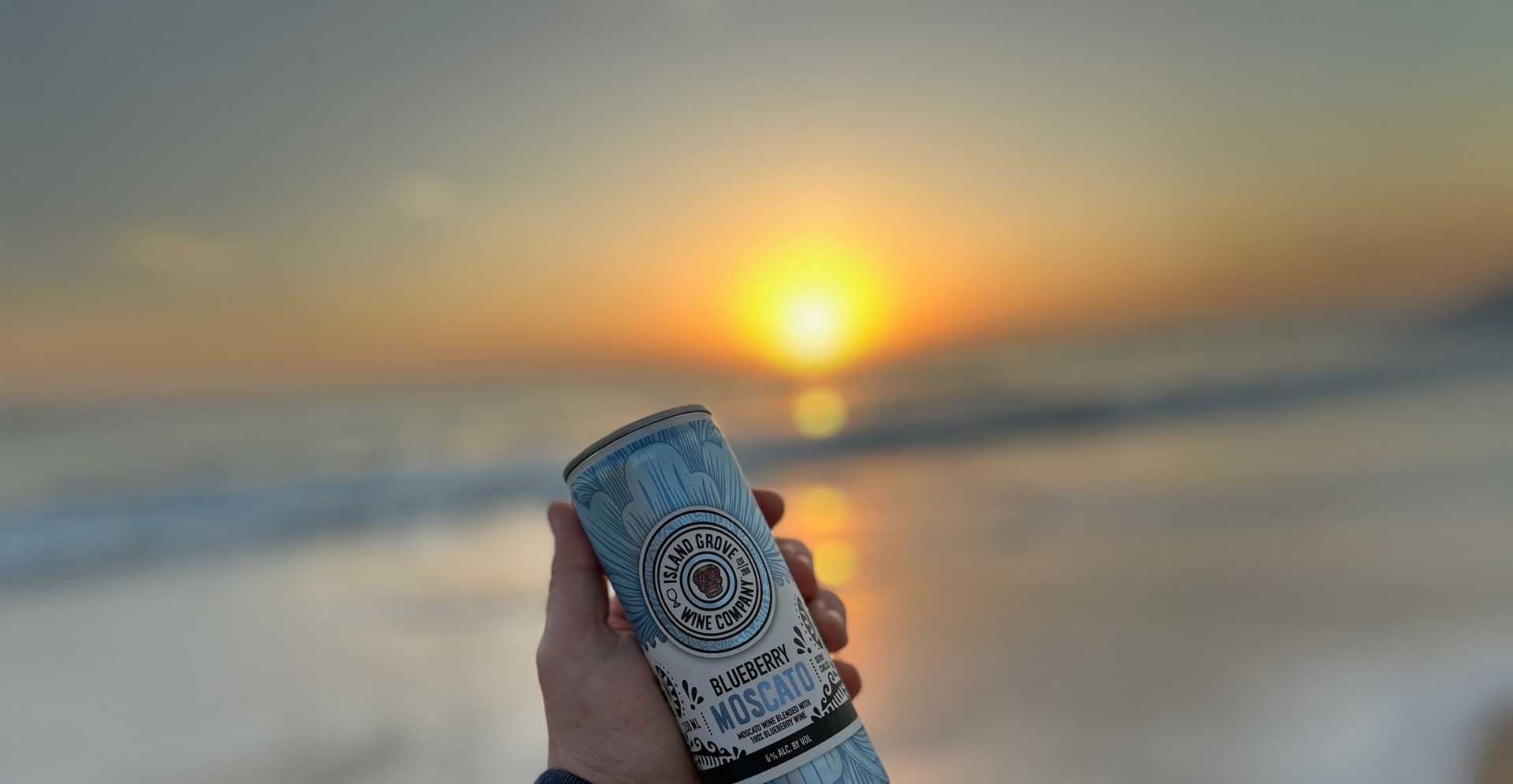
If you’re a seltzer person: start with the Blueberry Moscato (6% ABV)
This is the entry point. The one that doesn’t ask anything of you.
It opens with an immediate blueberry aroma — not artificial, not like blueberry candy, just blueberries — and it pours light and fizzy with fine bubbles. The sweetness is real but it’s smooth. The blueberry and moscato work together rather than fight, and there’s no bitterness, no harsh alcohol finish, nothing that’s going to make you feel like you made a wrong turn into wine territory.
At 6% it sits right in the seltzer zone, which is part of the point. If your whole thing with seltzer is that you want something light and easy that doesn’t make you feel like you’re drinking a glass of wine at a dinner party, this is your can.
Think of it as what a hard seltzer wishes it tasted like when it grew up.
Best for: long beach days, morning fishing trips that turn into afternoon fishing trips, anyone who has ever said “I don’t really like wine” and meant it.
If you’re a craft beer or IPA person: go straight to the Berry Sangria (11% ABV)
This one doesn’t apologize for being complicated.
It’s citrus-forward in a way that catches you off guard the first time — lemons, limes, oranges hit first, before the strawberries and blueberries and blackberries come in behind them. It’s tart. It has layers. At 11% it drinks like an actual drink, not a gesture toward one.
If you’ve spent years drinking IPAs specifically because you like bitter, complex things that reward attention, the Berry Sangria is the canned wine that makes sense for you. It’s not sweet. It’s not simple. It has an opinion.
This is the can you bring to a motocross event in the middle of Levy County when you’ve been standing in the sun for three hours and you want something that tastes like it knows where it is.
Best for: craft beer people, IPA drinkers, anyone who finds seltzer aggressively boring, long drives back from somewhere good.
Why the Florida part matters
I know it’s easy to gloss over the “locally made” angle because everyone says it now and it doesn’t always mean anything.
This one means something specific.
The blueberry farm that Island Grove Wine Company grows from is one of the largest organic blueberry operations in the Southeast. It’s in Hawthorne, which is the kind of town you drive through on the way to somewhere else unless you know what’s there. The winery is right next to the working farm. When you’re drinking one of their cans you’re about an hour from most of where you probably spend your weekends in Florida.
That’s not a marketing angle. That’s just what’s true. And it tastes different when you know it — not better in some pretentious way, just more like something that belongs here.
The practical stuff
- Size: 250mL cans — one can, one pour
- 4-packs and 24-can cases available online and at select retailers
- 200+ retail locations across Florida — Publix, Total Wine, and local spots
- Ships within Florida if you’d rather not leave the house
Find Island Grove cans online →
One last thing
I’m not going to tell you to throw out your seltzer. That would be strange and I don’t care enough.
But next time you’re packing a cooler out of habit, grab a 4-pack of the Blueberry Moscato and put it next to the White Claw. Drink both. See which one you reach for second.
That’s all this is. A field test with better scenery than your kitchen.
Cal out.